3D-QSAR
Simplify Drug Design

sexy 2050 video upd verified

Sexy 2050 Video - Upd Verified

Social backlash and cultural fault lines Even with robust verification, a sexy verified video can provoke backlash. Cultural conservatives may decry normalization of augmented eroticism; privacy advocates may warn about the chilling effect of recording and registering sexual encounters; marginalized communities may fear that verification systems replicate biases—whose identities are more easily verified, whose consent is trusted, and who benefits economically.

Conclusion: a mirror and a test A verified sexy video in 2050 functions as both mirror and test: it reflects evolving aesthetics of intimacy and tests the social, legal, and technical systems that govern mediated desire. Verification can protect agency and build trust, but it cannot substitute for robust norms, equitable economic arrangements, and vigilant protections against bias and coercion. The future of erotic media hinges on collective choices about how we encode consent, who controls provenance, and whether technological promise will expand freedom or entrench new inequalities. sexy 2050 video upd verified

Consent, agency, and legal frameworks Verification systems don’t eliminate power imbalances. They can, however, create enforceable records that help protect participants. Cryptographic timestamps and consent tokens provide evidence in disputes, and smart contracts can automate revenue splits and distribution limits. Law grapples with these tools: some jurisdictions recognize cryptographic consent as legally sufficient; others remain skeptical, requiring in-person verification or additional safeguards for vulnerable populations. Social backlash and cultural fault lines Even with

Designing verification for dignity To ensure verification supports dignity, designers must center informed consent, minimize unnecessary data exposure, and build recourse mechanisms. Principles include: minimal disclosure (prove only what’s necessary), decentralization (avoid single points of control), revocable consent (allow participants to withdraw distribution rights where feasible), and accessible verification (affordable and simple tools for independent creators). When implemented well, verification can make erotic media more ethical—ensuring performers are paid, consenting, and represented according to their terms. Verification can protect agency and build trust, but

Bodies, identities, and the aesthetics of desire The video’s aesthetics would reflect contemporary norms: bodies may be augmented, fluid across gender and species-templates, and choreography might blend physical movement with augmented overlays communicating internal states (arousal, safety boundaries, negotiated roles). The performers could be human, augmented humans, or legally recognized synthetic partners. Viewers’ interpretations would depend on how the video signals authenticity—if the provenance indicates live participants consenting in real time, audiences treat it differently than if it were generated or staged.

The conversation around such a video would reveal broader social fault lines: between those who prioritize freedom of erotic expression, those who emphasize protection from harm, and those anxious about corporate and state surveillance repurposing verification databases.

I’m not sure what you mean by “sexy 2050 video upd verified.” I’ll make a reasonable assumption and provide a complete, polished essay interpreting that phrase as a prompt to imagine a verified viral video from 2050 exploring changing norms around sexuality, technology, and verification. If you intended something else, tell me and I’ll revise. By 2050, the lines between physical intimacy, digital representation, and machine-mediated desire have blurred. A single verified video—widely circulated, algorithmically highlighted, and cryptographically authenticated—can crystallize debates about consent, identity, and the social architecture of attraction. This essay examines how a “sexy” 2050 video, verified and distributed across decentralized platforms, would reflect and shape cultural understandings of sexuality, technological trust, and the politics of verification.


sexy 2050 video upd verified

Social backlash and cultural fault lines Even with robust verification, a sexy verified video can provoke backlash. Cultural conservatives may decry normalization of augmented eroticism; privacy advocates may warn about the chilling effect of recording and registering sexual encounters; marginalized communities may fear that verification systems replicate biases—whose identities are more easily verified, whose consent is trusted, and who benefits economically.

Conclusion: a mirror and a test A verified sexy video in 2050 functions as both mirror and test: it reflects evolving aesthetics of intimacy and tests the social, legal, and technical systems that govern mediated desire. Verification can protect agency and build trust, but it cannot substitute for robust norms, equitable economic arrangements, and vigilant protections against bias and coercion. The future of erotic media hinges on collective choices about how we encode consent, who controls provenance, and whether technological promise will expand freedom or entrench new inequalities.

Consent, agency, and legal frameworks Verification systems don’t eliminate power imbalances. They can, however, create enforceable records that help protect participants. Cryptographic timestamps and consent tokens provide evidence in disputes, and smart contracts can automate revenue splits and distribution limits. Law grapples with these tools: some jurisdictions recognize cryptographic consent as legally sufficient; others remain skeptical, requiring in-person verification or additional safeguards for vulnerable populations.

Designing verification for dignity To ensure verification supports dignity, designers must center informed consent, minimize unnecessary data exposure, and build recourse mechanisms. Principles include: minimal disclosure (prove only what’s necessary), decentralization (avoid single points of control), revocable consent (allow participants to withdraw distribution rights where feasible), and accessible verification (affordable and simple tools for independent creators). When implemented well, verification can make erotic media more ethical—ensuring performers are paid, consenting, and represented according to their terms.

Bodies, identities, and the aesthetics of desire The video’s aesthetics would reflect contemporary norms: bodies may be augmented, fluid across gender and species-templates, and choreography might blend physical movement with augmented overlays communicating internal states (arousal, safety boundaries, negotiated roles). The performers could be human, augmented humans, or legally recognized synthetic partners. Viewers’ interpretations would depend on how the video signals authenticity—if the provenance indicates live participants consenting in real time, audiences treat it differently than if it were generated or staged.

The conversation around such a video would reveal broader social fault lines: between those who prioritize freedom of erotic expression, those who emphasize protection from harm, and those anxious about corporate and state surveillance repurposing verification databases.

I’m not sure what you mean by “sexy 2050 video upd verified.” I’ll make a reasonable assumption and provide a complete, polished essay interpreting that phrase as a prompt to imagine a verified viral video from 2050 exploring changing norms around sexuality, technology, and verification. If you intended something else, tell me and I’ll revise. By 2050, the lines between physical intimacy, digital representation, and machine-mediated desire have blurred. A single verified video—widely circulated, algorithmically highlighted, and cryptographically authenticated—can crystallize debates about consent, identity, and the social architecture of attraction. This essay examines how a “sexy” 2050 video, verified and distributed across decentralized platforms, would reflect and shape cultural understandings of sexuality, technological trust, and the politics of verification.

welcome to 3D-QSAR.com

Fast Molecule Management

Welcome to the first web application for Pharmaceutical Chemistry. 3D-QSAR.com offers user friendly and advanced tools for developing either ligand-based or structure-based 3D QSAR models and performing common useful operations over dataset of molecules.

Sign Up Know More
welcome to 3D-QSAR.com

Explore New Technologies

Our research team is always exploring new technologies and offering them as new products for you to use. Graph Neural Networks (GCNs) are a promising new frontier for Chemistry models development and we are working right now to make them part of the tools available to you.

Read More

Applications

Click on any button to start using the platform. If you want to know a bit more about the application, visit the link below to see all you will be able to do.

Explore Apps
In silico local QSAR modeling of bioconcentration factor of organophosphate pesticides Purusottam Banjare, Balaji Matore, Jagadish Singh, Partha Pratim Roy In Silico Pharmacology Evaluation of molecular structure based descriptors for the prediction of pEC50(M) for the selective adenosine A2A Receptor Nilima Rani Das, Sneha Prabha Mishra, P. Ganga RajuAchary Journal of Molecular Structure Alkylated monoterpene indole alkaloid derivatives as potent P-glycoprotein inhibitors in resistant cancer cells David S P Cardoso, Annamária Kincses, Márta Nové, Gabriella Spengler, Silva Mulhovo, João Aires-de-Sousa, Daniel J V A Dos Santos, Maria-José U Ferreira European Journal of Medicinal Chemistry Computational Studies of 3D-QSAR on a Highly Active Series of Naturally Occurring Nonnucleoside Inhibitors of HIV-1 RT (NNRTI) Waqar Hussain, Arshia Majeed, Ammara Akhtar and Nouman Rasool Journal of Computational Biophysics and Chemistry

A Valuable Tool

We are at the beginning of our journey but our work is already being recognized. These are the projects that mention 3D-QSAR.com as a valuable resource for their results and have been empowered with our tools. We thank you greatly.

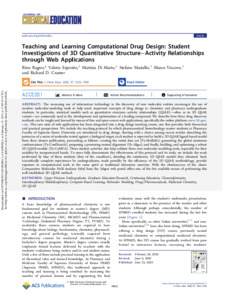
Paper: Teaching and learning computational
                              drug design: Studenti Investigations of 3D
                              Quantitative Structure–Activity Relationship
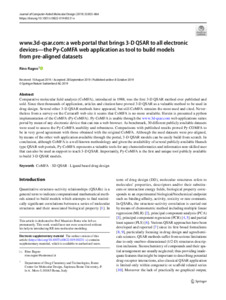
                              through Web Applications. Teaching and Learning Computational Drug Design... Journal of Chemical Education Paper: www.3d-qsar.com a web portal that brings
                              3-D QSAR to all electronic devices. the Py-CoMFA
                              web application as tool to build models from
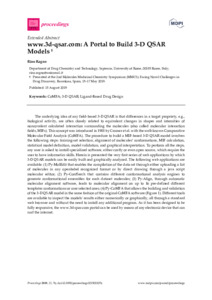
                              pre-aligned datasets. www.3d-qsar.com: a web portal that brings 3-D QSAR to all... Journal of Computer-Aided Molecular Design Paper: a portal to build 3-D QSAR Models. A Portal to Build 3-D QSAR Models. Proceedings

Reference Our Work

3D-QSAR.com is the result of an effort of our research team to offer valuable and easily accessible tools for the development of new active molecules. Cite our work by clicking on the pages or contact us directly.

Contact Us